By Ujjwal Porwal, Head of Infrastructure at L’Oréal India and IIT Kanpur alumnus. Last updated 16 November 2026.
Yes, DevOps is a good career for a fresher with a computer science or IT degree, but most freshers do not start with the title “DevOps engineer”. They start in a cloud support, junior cloud, build and release or operations role and move into DevOps within a year or two. If you plan for that route, your chances are good. If you apply only to jobs titled “DevOps engineer”, you will find very few that accept freshers.
This guide explains why, which job titles to target, what employers check, and what to do in your first six months.
Key points
- Fresher openings titled “DevOps engineer” are scarce. AmbitionBox’s salary bands for the title begin at two years of experience.
- Target entry-level titles that lead into DevOps: cloud support associate, junior cloud engineer, trainee DevOps engineer, build and release engineer, operations or NOC engineer.
- Employers check three things in a fresher: Linux and networking fundamentals, one cloud platform, and projects you built and can explain.
- A realistic first offer is between ₹3.5 lakh and ₹6 lakh a year.
- BSc IT, BSc CS, BCA, BE and BTech graduates are all eligible. Your projects matter more than which of these degrees you hold.
Why few listings say “DevOps fresher”
A DevOps engineer is trusted with the systems that build and release a company’s software. A mistake can stop every developers from working or take a live service down. Companies prefer to give that access to people who have already worked around production systems.
That is why the title usually comes with an experience requirement. It does not mean freshers are shut out of the field. It means the door is one step to the side.
The entry-level titles that lead into DevOps
| Job title to search for | What you do | How it leads to DevOps |
|---|---|---|
| Trainee or associate DevOps engineer | Support a senior engineer on pipelines and deployments | Direct route, but few openings |
| Cloud support associate | Resolve customer or internal issues on AWS or Azure | You learn a cloud platform in depth while being paid |
| Junior cloud engineer | Build and maintain cloud resources under supervision | Add automation and pipelines and the title follows |
| Build and release engineer | Run builds, manage releases, maintain pipeline tools | This is already half of a DevOps role |
| Operations, NOC or production support engineer | Monitor systems, respond to alerts, follow runbooks | You learn how real systems fail, which is the hardest part to teach |
| Linux system administrator | Manage servers, users, patches and backups | The traditional base for both cloud and DevOps roles |
Apply across all six. Your second job, not your first, is usually the one titled “DevOps engineer”.
What employers check in a fresher
Fundamentals. Linux commands, file permissions, processes, basic networking (IP addresses, DNS, ports, HTTP) and Git. Fresher interviews usually start here, not with advanced tools.
One cloud platform. AWS or Azure, to the level where you can launch a server, put it in a network, secure it and deploy an application on it without a tutorial open.
Projects you can explain. Two or three, on GitHub, each with a README. Interviewers will ask why you made each choice and what all broke along the way.
Communication. Can you explain a technical problem clearly? Much of the job is talking to developers under time pressure.
A certification helps your resume get read but does not replace any of these. See our guide to DevOps certifications for which one to take first.
Three projects that work in fresher interviews
- A website deployed the long way, then the automated way. Host a simple application on a cloud server by hand. Then write a pipeline that tests and deploys it automatically on every code change. Explain what the automation saved.
- An application in containers on Kubernetes. Package a small application with its database in Docker, run it on a Kubernetes cluster, and show what happens when you delete a running container.
- Infrastructure from code. Create a network, a server and a database on AWS or Azure using Terraform. Destroy it and rebuild it in front of the interviewer.
Build them yourself, an interviewer finds out within two questions whether a project was copied.
A six-month plan for a fresher
| Month | Focus | You should be able to |
|---|---|---|
| 1 | Linux, networking basics, Git | Work entirely from the command line; explain what happens when you open a website |
| 2 | Scripting in Bash and basic Python; one cloud platform | Automate a small task; launch and secure a server |
| 3 | Docker and build pipelines | Package an application and deploy it automatically; finish project 1 |
| 4 | Kubernetes | Run and troubleshoot an application on a cluster; finish project 2 |
| 5 | Terraform and monitoring | Build infrastructure from code; set up a dashboard and an alert; finish project 3 |
| 6 | Resume, mock interviews, applications | Explain each project in five minutes; apply across all six job titles |
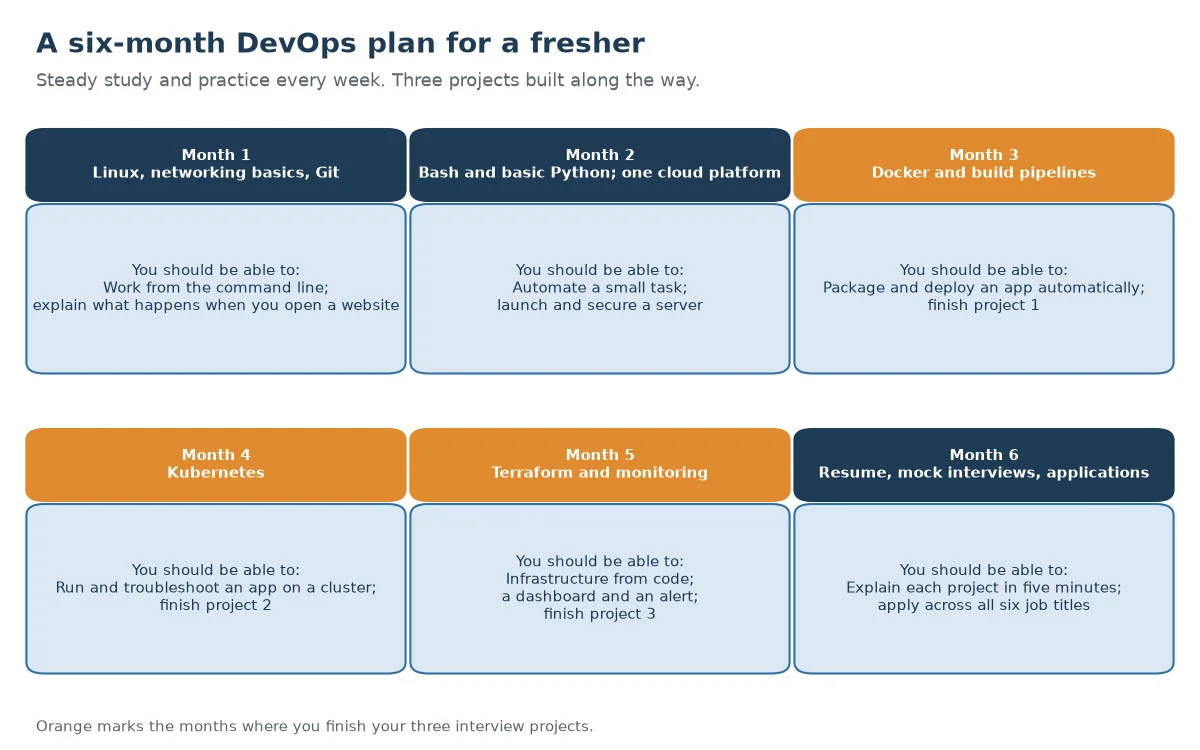
This assumes steady study and practice every week. Final-year students can start in their last semester and be ready to apply when results come out.
What does a fresher earn?
Reported starting figures for DevOps roles in India run from about ₹3.6 lakh to ₹4.5 lakh a year, and a realistic first offer is between ₹3.5 lakh and ₹6 lakh. Pay rises quickly from there: about ₹6 lakh at two years and ₹10 lakh to ₹11 lakh at five. Sources and dates are in our DevOps engineer salary guide.
Be carefull with advertisements that promise freshers ₹8 lakh or ₹10 lakh. The salary data does not support that as a typical outcome.
Five mistakes freshers make
- Applying only to “DevOps engineer” listings. Use the six titles above.
- Skipping Linux and networking to get to Kubernetes. Interviews start with the basics.
- Collecting certificates instead of building projects.
- Learning ten tools a little. Learn one tool in each category properly.
- Copying projects from tutorials. Change the application, break it, fix it, and write down what you learned.
Does your degree matter?
For these roles, employers generally ask for a degree in computer science, IT or a related field. BSc IT, BSc CS, BCA, BE and BTech all qualify. Some employers apply their own academic cut-offs, so read each listing.
Among our own students, about three in ten are freshers or final-year students, and nearly all of them are 24 or younger. They hold a mix of BSc IT, BSc CS, BCA, BE and BTech degrees.
DevOps or software development as a first job?
Both are sound choices. Development generally has more fresher openings and a clearer first title. DevOps and cloud suit people who enjoy systems, networks and troubleshooting more than writing application features. If you like finding out why something broke, you will probably enjoy this work.
How our classroom program fits
Our 4-month classroom program covers the plan above with a trainer in the room, and it is open to CS and IT graduates and final-year students. Our commitment on placement is specific. Placement assurance: 5 assured MNC interviews for students who complete the program requirements. That is interview access, not a job offer. 450+ students placed.
DevOps Institute Mumbai is an authorised Offline Training Partner of Edzor, delivering the Professional Certification in DevOps Engineering on Cloud and AI Infrastructure, with IIT Patna Vishlesan iHub Foundation as knowledge partner. It is not a degree or diploma from IIT Patna.
See the DevOps engineer course curriculum and how placement works.
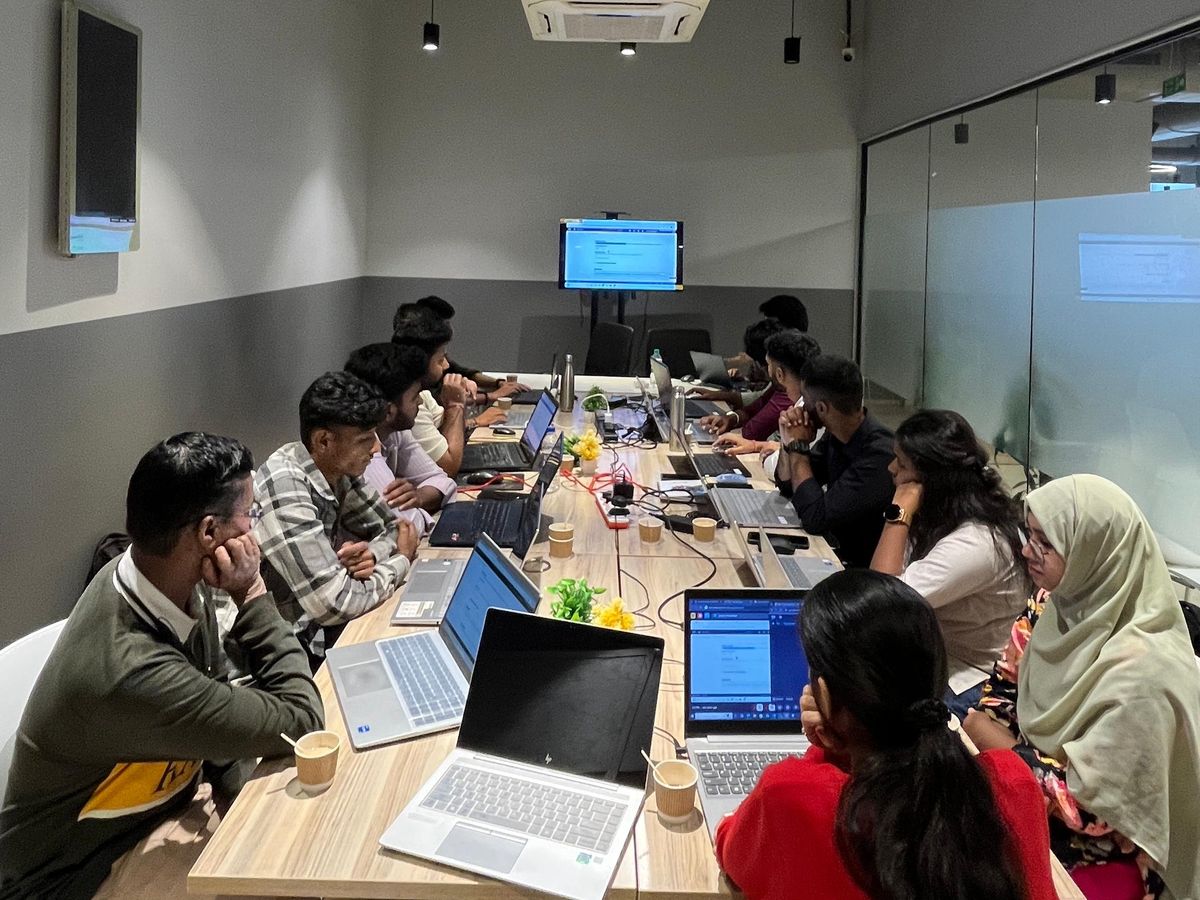
Thinking about a classroom DevOps course in Mumbai?
DevOps Institute Mumbai runs 4-month classroom programs for CS and IT graduates at Thane, Vashi, Ghatkopar and Powai. Placement assurance: 5 assured MNC interviews. That is interview access, not a job offer. 450+ students placed. 350+ hiring partners.
We teach in classrooms only. If you want an online-only course, or a job without the training, we are not the right fit.
Frequently asked questions
Can a fresher get a job as a DevOps engineer?
Yes, but usually through an entry-level cloud, support, operations or build and release role first. Direct fresher openings titled “DevOps engineer” exist but are few.
Is DevOps hard for beginners?
It is broad more than hard. You need working knowledge of Linux, networking, a cloud platform, containers and automation. Learned in the right order with regular practice, a CS or IT graduate can cover it in about six months.
Does DevOps require coding?
It requires scripting, not full software development. You should be able to write Bash and basic Python and read configuration files.
Can a BSc IT or BCA graduate become a DevOps engineer?
Yes. BSc IT, BSc CS and BCA graduates are eligible for the same entry-level roles as BE and BTech graduates. Projects and interview performance matter more than which degree you hold.
What is the salary of a DevOps fresher in India?
Reported starting figures run from about ₹3.6 lakh to ₹4.5 lakh a year. A realistic first offer is between ₹3.5 lakh and ₹6 lakh.
How long does it take a fresher to learn DevOps?
About six months of steady study and practice to be ready for entry-level interviews, less with structured training.
Should I do a DevOps course in my final year?
Yes, if you can give it steady time alongside your final-semester work. Starting in your last semester lets you apply as soon as results are out.