By Ujjwal Porwal, Head of Infrastructure at L’Oréal India and IIT Kanpur alumnus. Last updated 16 November 2026.
Self-paced online courses are the cheapest and most flexible way to learn DevOps, and they work for disciplined people who already have a technical base. Classroom training costs more and fixes your schedule, and it works better for people who need doubts answered on the spot and a reason to turn up every week. Live online classes sit in between.
We run classrooms, so we have a side in this. We have tried to write the comparison we would want to read before spending our own money, including the cases where a classroom is the wrong choice.
Key points
- Choose self-paced online if you are disciplined, already work with Linux or cloud, and mainly need structure and content.
- Choose a classroom if you have started online courses and not finished them, or you get stuck and have nobody to ask.
- Choose live online if no good classroom is within about an hour of you.
- The format matters less than three things: who teaches, how much you build with your own hands, and whether anyone checks your work.
- Ask any institute, including us, the eight questions at the end before you pay.
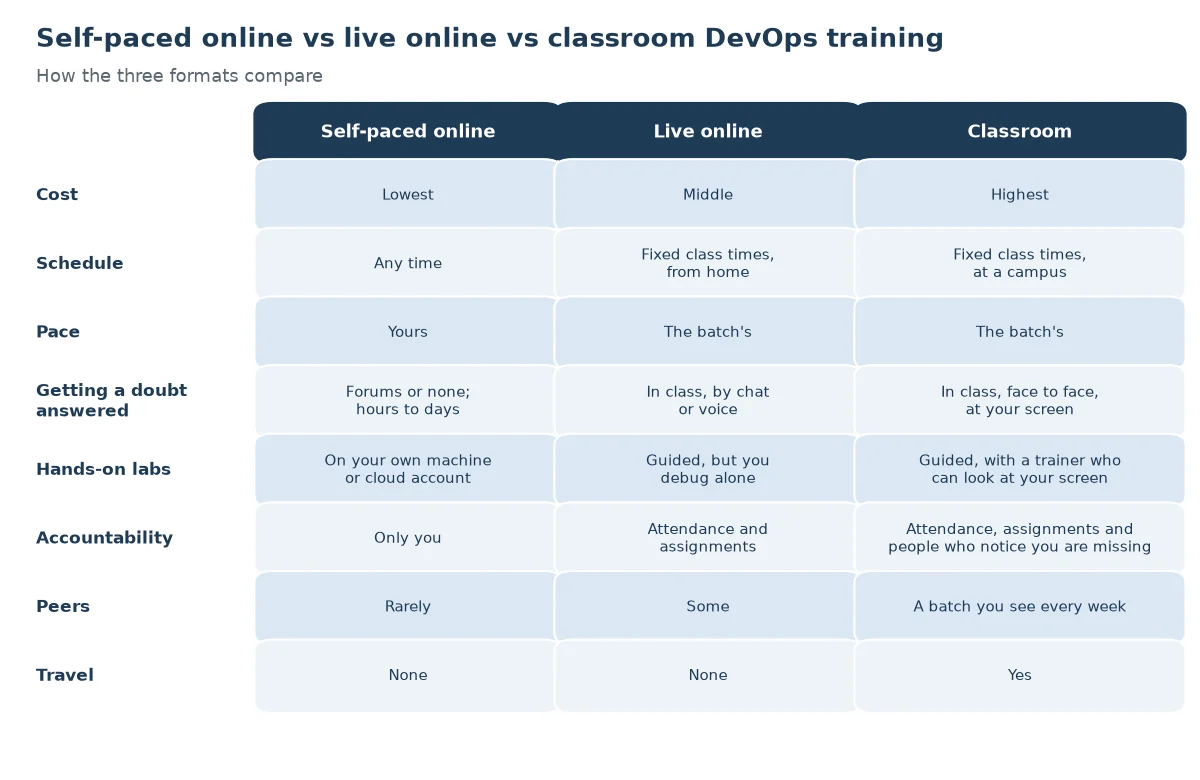
The three formats compared
| Self-paced online | Live online | Classroom | |
|---|---|---|---|
| Cost | Lowest | Middle | Highest |
| Schedule | Any time | Fixed class times, from home | Fixed class times, at a campus |
| Pace | Yours | The batch’s | The batch’s |
| Getting a doubt answered | Forums or none; hours to days | In class, by chat or voice | In class, face to face, at your screen |
| Hands-on labs | On your own machine or cloud account | Guided, but you debug alone | Guided, with a trainer who can look at your screen |
| Accountability | Only you | Attendance and assignments | Attendance, assignments and people who notice you are missing |
| Peers | Rarely | Some | A batch you see every week |
| Travel | None | None | Yes |
| Works best for | Self-starters with a technical base | People far from a campus who still need a schedule | People who need structure, quick answers and a fixed routine |
When self-paced online is the right choice
Self-paced courses are excellent value. The content from the major platforms is often very good, and you can repeat a lesson as many time as you need.
They suit you if:
- You already work with Linux, networks or a cloud platform and can debug your own setup.
- You have finished a long self-paced course before.
- You want one specific skill, such as Terraform or Kubernetes, not a complete career change.
- Your shifts change week to week and you cannot commit to fixed class times.
The weakness is not the content, it is that nobody notices when you stop.
When a classroom is the right choice
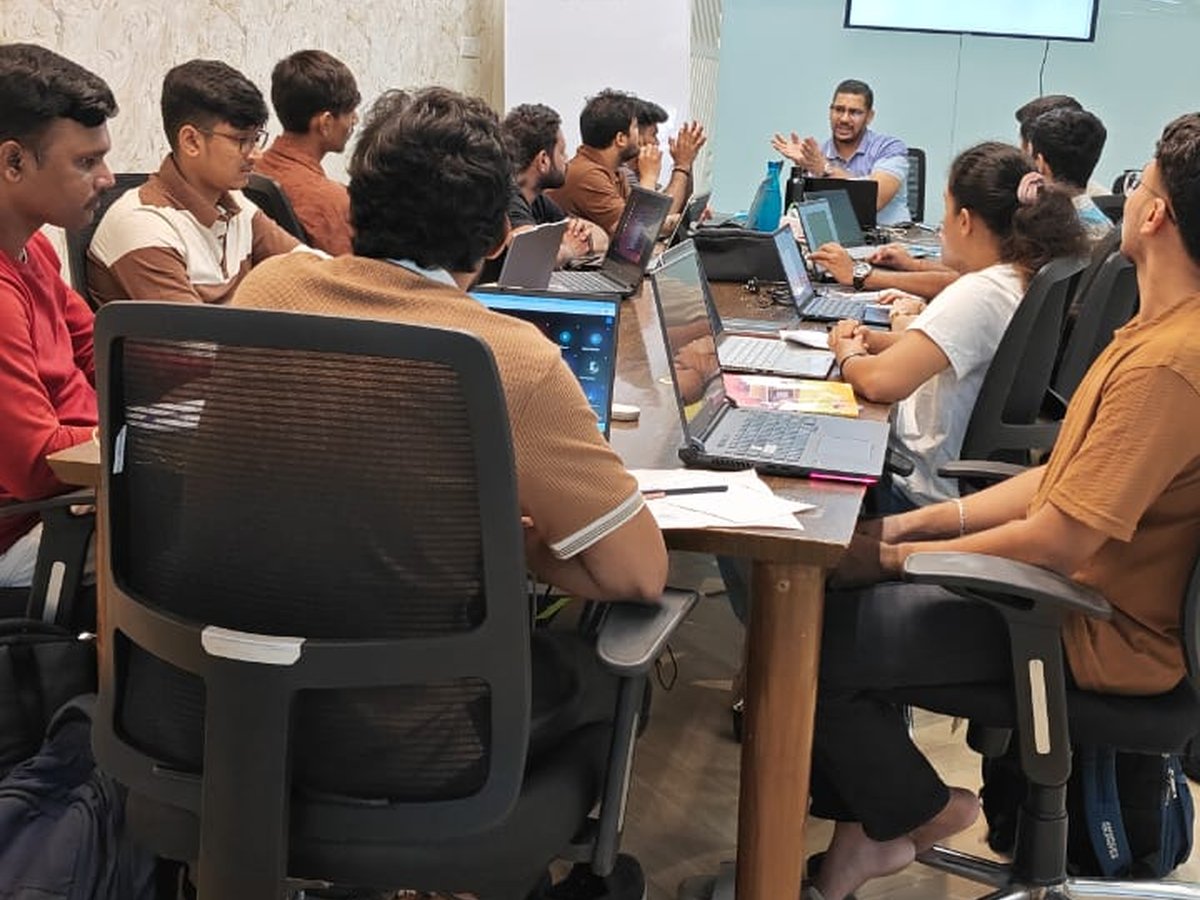
A classroom gives you three things a recording cannot: a fixed time that protects your study hours, a trainer who can look at you screen when a command fails, and a group moving at the same pace.
It suits you if:
- You have bought online courses and not completed them.
- You are changing field, for example from support or testing, and do not yet know what you do not know.
- You learn faster by asking than by searching.
- You can reach a campus reliably every week.
This matches what our own students say. In 74 written Google reviews of our institute, 66% mention the trainers, 41% mention hands-on or project work, 38% mention doubt-solving and support, and 27% mention the classroom format itself. A line that recurs is some version of: I had paid for online courses before and did not get anywhere.
When a classroom is the wrong choice
A classroom is a poor fit if:
- You live or work more than about an hour from the campus. The travel will wear you down before the course ends.
- Your employer changes your shifts without notice.
- You only want a certificate, or you want a job without doing the training.
- Your budget only covers a low-cost online course. Take the online course and do it properly. That is better than borrowing for a classroom.
We would rather tell you this before you enrol than after.
What matters more than the format
Who teaches. A working engineer who has run production systems teaches differently from someone reading slides. Ask for the trainer’s name and look them up.
How much you build. You should leave with projects you made yourself and can explain: a working delivery pipeline, an application running on Kubernetes, infrastructure defined in Terraform. Watching someone else type does not count.
Whether anyone checks your work. Feedback on your own project, your resume and a mock interview is worth more than extra hours of lectures.
Eight questions to ask any institute before you pay
- Who will teach my batch? May I see their LinkedIn profile?
- How many students are in a batch?
- May I sit in one class before I enrol?
- What exactly does “placement” mean here? May I have it in writing?
- May I speak to two students from a recent batch?
- Do I get lab access and class recordings, and for how long?
- What is the refund policy?
- Who issues the certificate, and what is it exactly?
An institute who answers these plainly is worth considering. One that avoids them is not.
Our own answers
- Trainers. We introduce you to your trainer at the career call.
- Batch size. We confirm the batch size for your campus on the career call.
- Trial class. Ask us on the career call.
- Placement. Placement assurance: 5 assured MNC interviews for students who complete the program requirements. That is interview access, not a job offer and not a salary promise. 450+ students placed. 350+ hiring partners.
- Past students. Read our Google reviews.
- Labs and recordings. We confirm lab and recording access on the career call.
- Refunds. Our refund policy is published on this website.
- Certificate. DevOps Institute Mumbai is an authorised Offline Training Partner of Edzor, delivering the Professional Certification in DevOps Engineering on Cloud and AI Infrastructure, with IIT Patna Vishlesan iHub Foundation as knowledge partner. It is not a degree or diploma from IIT Patna.
See the DevOps engineer course page for the curriculum, or find a campus: Thane, Navi Mumbai (Vashi), Ghatkopar. We also teach at Powai.
Thinking about a classroom DevOps course in Mumbai?
DevOps Institute Mumbai runs 4-month classroom programs for CS and IT graduates at Thane, Vashi, Ghatkopar and Powai. Placement assurance: 5 assured MNC interviews. That is interview access, not a job offer. 450+ students placed. 350+ hiring partners.
We teach in classrooms only. If you want an online-only course, or a job without the training, we are not the right fit.
Frequently asked questions
Can I learn DevOps online on my own?
Yes. Everything you need is available online, much of it free. It works best if you already have a technical base and the discipline to practise every week without anyone checking.
Is classroom training better than online for DevOps?
Not for everyone. It is better for people who need a fixed schedule and quick answers when they are stuck. It is worse for people with unpredictable shifts or a long commute.
Is an offline DevOps course worth the higher cost?
It is worth it only if you attend every class and build the projects. The value is in the trainer’s time and the routine, so ask the eight questions above before you decide.
Can I do a classroom DevOps course while working full time?
Yes, if the classes are on weekends and you can reach the campus reliably. Plan for practice time during the week as well as the class hours.
What should I check before joining a DevOps institute?
Who teaches, batch size, whether you can try a class, the written meaning of “placement”, access to past students, lab and recording access, the refund policy, and who issues the certificate.
Do employers care whether I learned online or in a classroom?
No. Employers look at what you can do in the interview and the projects you can explain. They rarely ask how you learned.