By Ujjwal Porwal, Head of Infrastructure at L’Oréal India and IIT Kanpur alumnus. Last updated 16 November 2026.
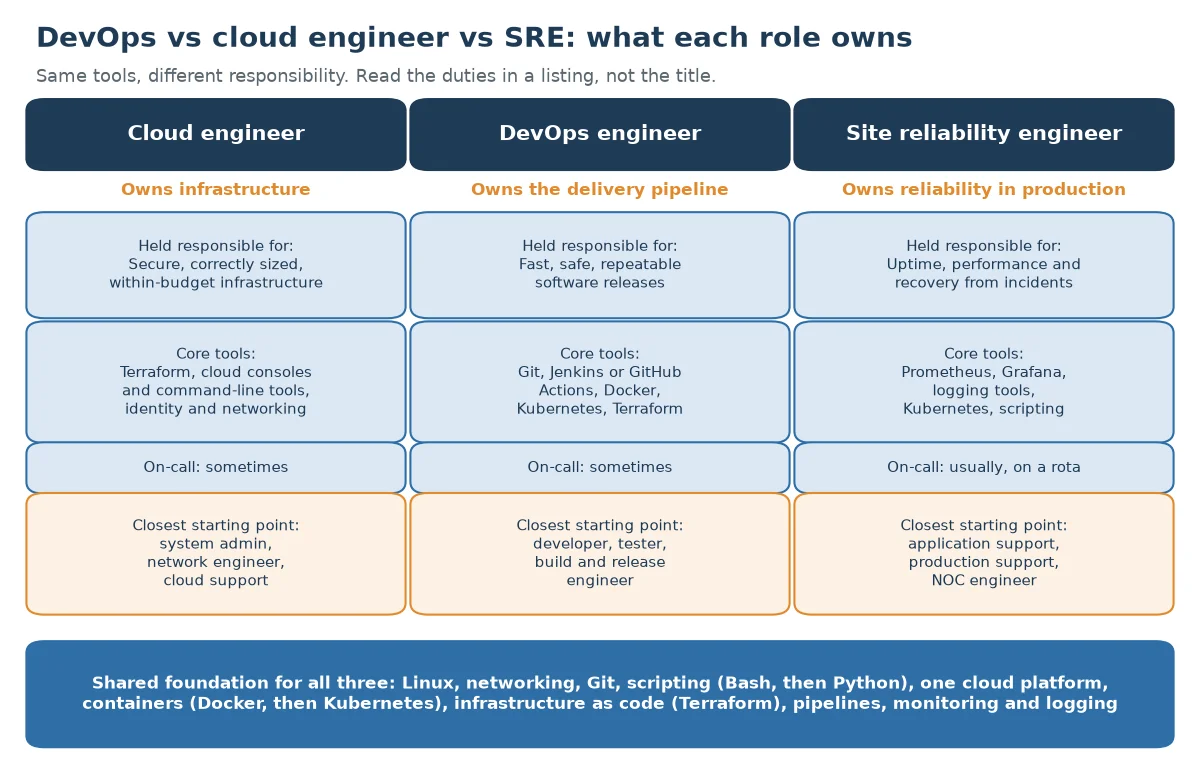
A cloud engineer builds and runs the infrastructure. A DevOps engineer automates how software gets from a developer’s laptop to that infrastructure. A site reliability engineer (SRE) keeps the running system fast and available, and fixes it when it breaks. The three roles share most of their tools. They differ in what you are held responsible for.
If you work in IT support, system administration, networking or testing today, one of these is a closer step from your current job than the others. This guide will help you to pick.
Key points
- Cloud engineer: owns infrastructure. Closest step for system and network administrators.
- DevOps engineer: owns the delivery pipeline. Closest step for developers, testers and build or release staff.
- SRE: owns reliability in production. Closest step for application and production support engineers.
- Job titles are used loosely. Read the responsibilities in a listing, not the title.
- All three need the same foundation: Linux, networking, Git, scripting, one cloud platform, containers and monitoring.
The three roles side by side
| Cloud engineer | DevOps engineer | Site reliability engineer | |
|---|---|---|---|
| Held responsible for | Infrastructure that is secure, sized correctly and within budget | Fast, safe, repeatable software releases | Uptime, performance and recovery from incidents |
| Typical day | Building networks, servers, storage and access rules on AWS, Azure or Google Cloud | Writing and fixing build and release pipelines; packaging applications in containers | Watching dashboards and alerts, handling incidents, removing repeat causes of failure |
| Core tools | Cloud consoles and command-line tools, Terraform, identity and networking services | Git, Jenkins or GitHub Actions, Docker, Kubernetes, Terraform | Prometheus, Grafana, logging tools, Kubernetes, scripting |
| Coding needed | Scripting and infrastructure as code | Scripting, pipeline code, some application reading | More than the other two: automation in Python or Go is common |
| On-call | Sometimes | Sometimes | Usually, on a rota |
| Closest starting point | System administrator, network engineer, cloud support | Developer, tester, build and release engineer | Application support, production support, NOC engineer |
What a cloud engineer does
A cloud engineer designs, builds and maintains infrastructure on a cloud platform: virtual networks, servers, storage, databases, identity and access. The work is close to traditional system and network administration, moved onto AWS, Azure or Google Cloud and defined in code instead of clicked together by hand.
This role suits you if you are already thinking in terms of servers, subnets, firewalls and backups.
What a DevOps engineer does
A DevOps engineer builds the automated path that takes code from a developer’s commit to a running service. That means source control, automated builds and tests, container images, deployment to Kubernetes or cloud services, and the infrastructure code behind it all.
The measure of success is how often and how safely a team can release. This role suits you if you like removing manual steps and you are comfortable reading other people’s code.
What an SRE does
Site reliability engineering began at Google as a way of running production systems with software engineering methods. An SRE defines how reliable a service needs to be, measures it, responds when it falls short, and writes automation so the same failiure does not need a human next time.
This role suits you if you stay calm during an outage and want to know why it happened, not only how to restart the service.
Where the roles overlap
In small company one person does all three jobs under the title “DevOps engineer”. In a large company they are separate teams. Many listings titled “DevOps engineer” are mostly cloud administration, and many “cloud engineer” listings expect pipeline work.
You will also see “platform engineer”. That is usually a DevOps engineer who builds internal tools and templates for other engineering teams to use.
So judge a job by its listed responsibilities. Three questions sort most listings:
- Will I mostly build infrastructure, build pipelines, or respond to production issues?
- Is there an on-call rota, and how often?
- How much code will I write in a week?
Which role fits your current job?
| If you work as | Skills you already have | Closest role | What to add first |
|---|---|---|---|
| Linux or Windows system administrator | Servers, users, patching, backups, shell | Cloud engineer | One cloud platform, Terraform |
| Network engineer | Routing, firewalls, DNS, load balancing | Cloud engineer with a networking focus | Cloud networking, Linux, scripting |
| Application or production support | Incident handling, logs, monitoring, shift work | SRE or DevOps engineer | Linux depth, scripting, containers |
| Desktop or helpdesk support | Troubleshooting, ticketing, user access | Cloud support or junior cloud engineer | Linux, networking basics, one cloud platform |
| Database administrator | Backups, performance, availability | Cloud engineer with a database focus | Managed cloud databases, Terraform |
| Developer | Code, Git, build tools | DevOps engineer | Linux, containers, cloud, pipelines |
| Manual or automation tester | Test cases, release cycles, defect tracking | DevOps engineer | Git, scripting, pipelines, containers |
About three in ten students who join us come from the IT support and infrastructure jobs in the first five rows. The experience you have from those jobs count. Someone who has handled real incidents at 3 a.m. has something a fresher cannot learn from a course.
The foundation all three share
Whichever role you aim for, learn these in roughly this order:
- Linux administration and the command line
- Networking basics: IP addressing, DNS, HTTP, load balancing, firewalls
- Git
- Scripting in Bash, then Python
- One cloud platform to working depth, AWS or Azure
- Docker, then Kubernetes
- Infrastructure as code with Terraform
- Build and release pipelines
- Monitoring and logging
If you already work in infrastructure, you can move through the first two quickly. A developer can move quickly through the third and fourth.
Which role pays more?
The titles overlap too much for a clean answer. Pay depends more on your experience, the type of employer and how deep your skills go than on which of the three titles you hold. Our DevOps engineer salary guide gives figures by experience and city, with sources.
How our classroom program fits
Our 4-month classroom program covers the shared foundation above, which is what cloud, DevOps and junior SRE roles all ask for. Classes are held in classrooms at Thane, Vashi, Ghatkopar and Powai. Ask us for the current weekend batch schedule.
The program is for CS and IT graduates. See the DevOps engineer course, the SRE course, the DevOps and cloud computing course, or the page for working professionals.
Thinking about a classroom DevOps course in Mumbai?
DevOps Institute Mumbai runs 4-month classroom programs for CS and IT graduates at Thane, Vashi, Ghatkopar and Powai. Placement assurance: 5 assured MNC interviews. That is interview access, not a job offer. 450+ students placed. 350+ hiring partners.
We teach in classrooms only. If you want an online-only course, or a job without the training, we are not the right fit.
Frequently asked questions
Is a DevOps engineer the same as a cloud engineer?
No, although the jobs overlap. A cloud engineer is responsible for the infrastructure. A DevOps engineer is responsible for the automated process that builds and releases software onto it. In small companies one person often does both.
What is the difference between DevOps and SRE?
DevOps focuses on releasing software quickly and safely. SRE focuses on keeping the released software reliable in production. SREs usually carry on-call duty and write more automation code.
Which is easier to move into from IT support: DevOps, cloud or SRE?
From system or network administration, cloud engineering is the shortest step. From application or production support, SRE and DevOps are closer because you already handle incidents, logs and monitoring.
Can a network engineer become a cloud engineer?
Yes. Cloud platforms are built on the same networking concepts: subnets, routing, firewalls, DNS and load balancing. Add Linux, scripting and one cloud platform.
Do I need to know coding for DevOps?
You need scripting, not software development. You should be able to write Bash and basic Python, and read configuration and pipeline files. SRE roles expect more coding than cloud or DevOps roles.
Should I learn AWS or Azure first?
Learn the one your target employers use. Check job listings in your city and count. The concepts carry over, so your second cloud takes far less time than your first.